
South Florida remains one of the most dynamic real estate markets in the nation, but navigating today's ecosystem requires looking beyond headline figures. Whether you own a high-rise oceanfront condo or a luxury single-family residence, understanding micro-market nuances across Miami Beach, Miami-Dade, and Broward County is essential for maximizing yield and protecting your investment.
The Barrier Island Premium vs. Mainland Realities
When analyzing rental values, Miami Beach operates as a distinct micro-market. Because Miami Beach is a barrier island—a geographically fixed strip of land bounded by Biscayne Bay and the Atlantic Ocean—land is permanently scarce. Mainland Miami-Dade and Broward counties can develop outward, but island supply is naturally capped.
This structural land scarcity explains why single-family homes and luxury condos on the island command premiums double or triple those of mainland submarkets:
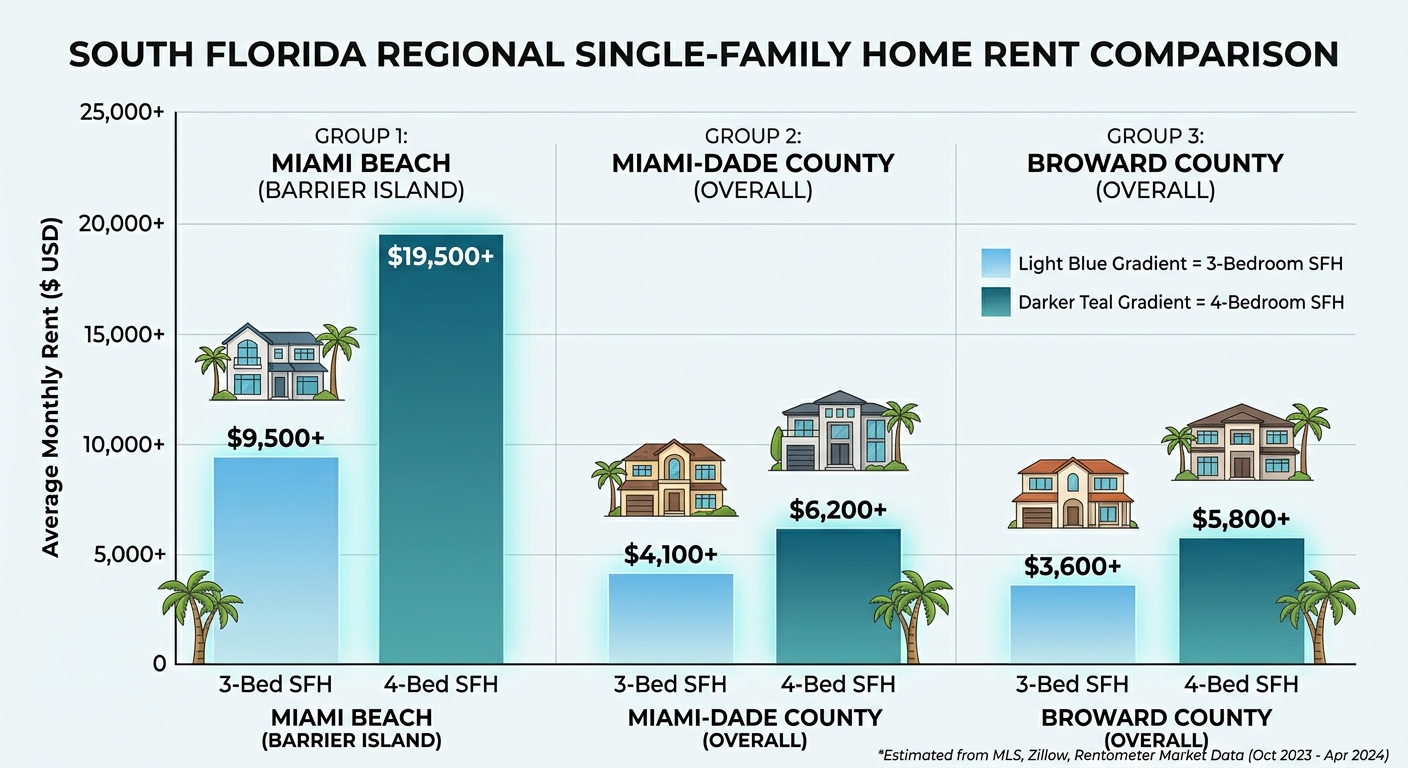
Single-Family Single-Family Rents: While 3-bedroom houses average $3,800–$4,400/month in broader Miami-Dade and $3,500–$3,700/month in Broward, Miami Beach single-family homes average $8,500–$10,500+/month.
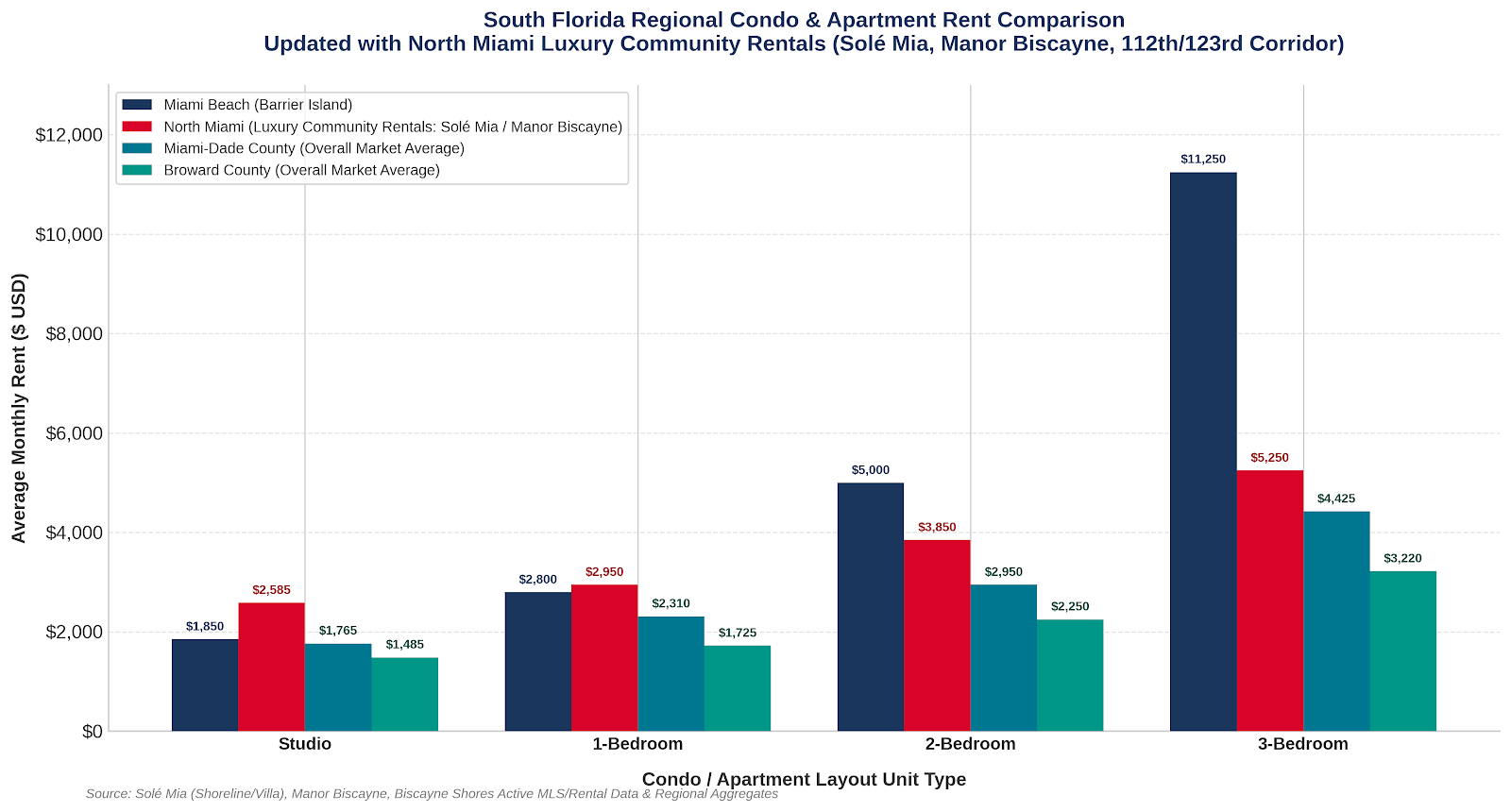
Luxury Condos: A 2-bedroom condo averages $2,250/month in Broward and $2,950/month in Miami-Dade, whereas the same layout on Miami Beach commands $5,000/month.
Why Luxury Properties Sit Longer in Today’s Market
If you own a luxury single-family property or high-end residence in South Florida, you may have noticed that placing a listing on the MLS no longer guarantees immediate leads or quick lease signings. It is increasingly common for properties priced at $11,000–$11,500/month to sit for several weeks without inquiries.
Four distinct market shifts explain why listings take longer to capture qualified tenants:
Rising Active Inventory: Active single-family and luxury rental inventory across South Florida has expanded nearly 39% year-over-year. Tenants have significantly more choices and are taking extra time to evaluate competing properties.
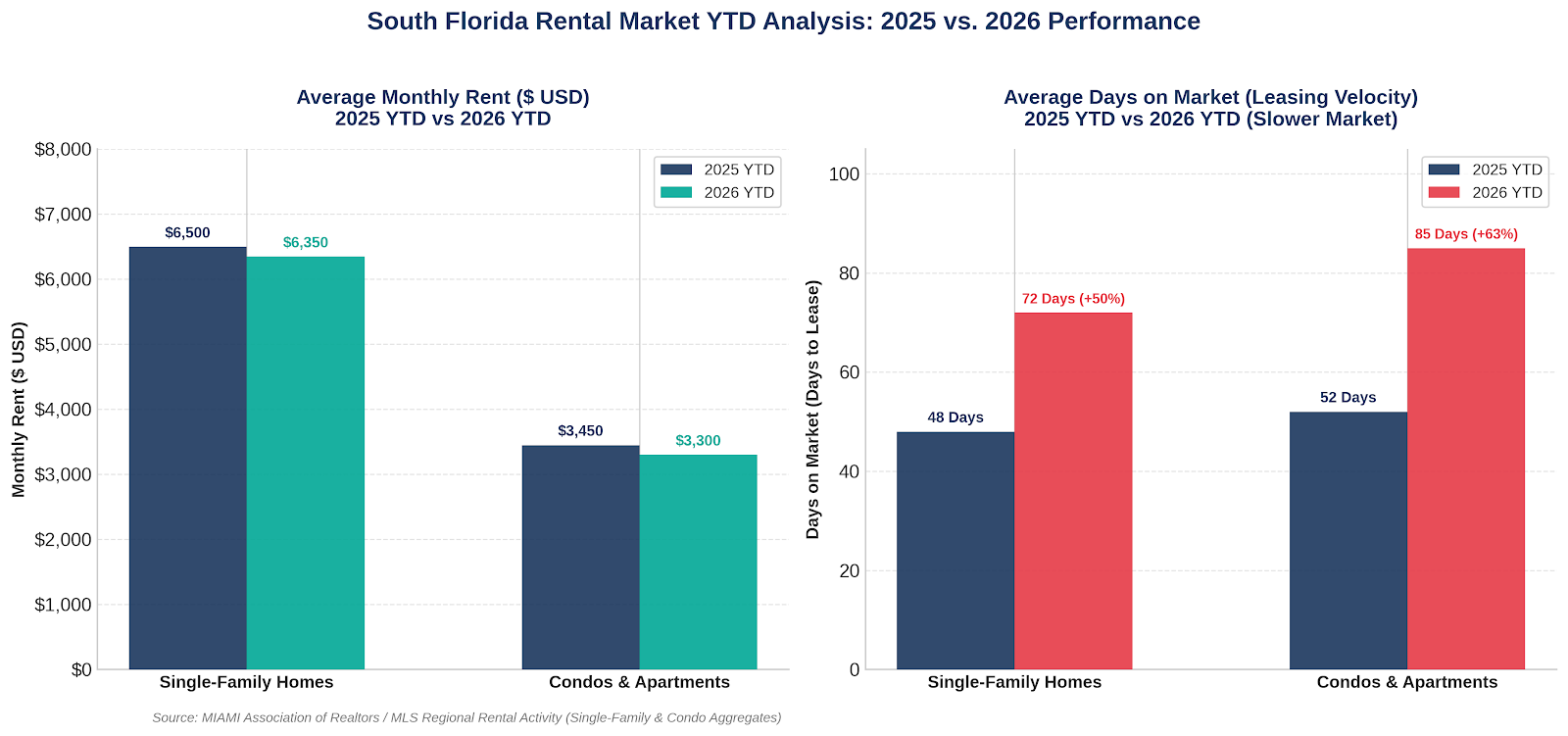
Extended Days on Market (DOM): Average marketing times across Miami-Dade now stretch between 80 to 100+ days. A 2-to-3-week window with minimal inquiry activity is the current market baseline rather than an indicator of low property value.
Seasonal Demand Shifts: Late summer and early autumn represent a natural lull in luxury relocations before the annual winter influx begins in late November.
The $10,000/Month Threshold: Tenants paying over $120,000 annually expect turnkey finishes, pool or waterfront amenities, and prime location. When price points exceed market tolerance, tenants simply wait for adjustments or move toward mainland luxury towers.
The market pulse : How today's rental velocity compare to last year?
If you speak with property owners across South Florida, a common question arises: "Why are my listings sitting vacant longer than they did last year?"
The shift in market velocity is driven by four primary factors:
Extended Days on Market (DOM): While properties leased almost instantly during peak demand cycles, average listings today spend 70 to 85+ days on the market. This is standard behavior for a normalized market, making initial pricing accuracy critical.
Expanded Regional Inventory: A steady influx of new multi-family units across Miami-Dade gives prospective tenants options and negotiating power, eliminating the extreme inventory squeeze of prior years.
Sharper Seasonal Demand Swings: South Florida has returned to pronounced seasonal cycles. Late summer through early autumn marks the slowest period for both short-term occupancy and long-term lease signings, while late fall through spring brings peak momentum.
Tenant Price Resistance: Asking rents across the region have stabilized. Renters no longer accept inflated rates for generic or un-renovated units without top-tier amenities and professional management.
Micro-Market Realities & Island Scarcity: Decoding Miami Beach
Evaluating South Florida real estate requires looking past general county-wide averages to analyze street-level constraints. On Miami Beach, physical geography dictates the market.
As a barrier island bounded by Biscayne Bay and the Atlantic Ocean, Miami Beach has no room for outward geographical expansion. This inherent land scarcity creates unique inventory dynamics, particularly when evaluating larger residential layouts.
The 3-Bedroom Market Analysis: Why the Average Hits $11,250/Month
Aggregate market reports frequently list the average rent for a 3-bedroom condo on Miami Beach around $11,250/month. Property owners often notice a massive price gap when moving from standard 2-bedroom units to 3-bedroom listings. This sharp divergence is driven by two key structural realities:
The Math Behind the "Average" (Mean vs. Median): Market aggregators calculate the mean across all active MLS listings. Ultra-luxury oceanfront towers in South of Fifth (SoFi), the Continuum, Setai, and Edition list 3-bedroom residences and penthouses ranging from $15,000 to $35,000+ per month. These ultra-high-end properties mathematically pull the overall island average significantly upward.
Floor Plan Rarity: Most condo developments on the island were built with studios, 1-bedrooms, and 2-bedrooms. 3-bedroom floor plans represent a tiny fraction of total island inventory. Because they are rare, developers historically reserved 3-bedroom layouts for prime upper floors, high-tier corner units, or multi-level penthouses with sweeping water views.
To understand true market positioning, Miami Beach 3-bedroom condo rentals break down into three distinct property tiers:
Property Tier Monthly Rent Range Building & Location Profile Boutique / Inland / Non-Waterfront $6,500 – $8,500
Normandy Isles, North Beach non-oceanfront units, older boutique mid-rises
Standard High-Rise / Interior Condo$8,500 – $10,500
Mid-Beach interior condos, renovated mid-century towers with standard amenities
Luxury High-Rise & Oceanfront$12,000 – $25,000+
South of Fifth (SoFi), Continuum, Setai, Edition, ultra-luxury oceanfront penthouses
The Rise of North Miami: Luxury "Community Rentals" vs. Independent Landlords
While Miami Beach deals with island supply constraints, a major structural shift is taking place in North Miami along the Biscayne Boulevard corridor (112th Street to 155th Street).
Historically, older garden-style apartments in North Miami rented for $1,800–$2,100 per month. However, the arrival of massive institutional Community Rentals—professionally managed build-to-rent complexes like Solé Mia (Shoreline, Villa Solé, Laguna), The Manor Biscayne, and Biscayne Shores—has established elevated price floors for the entire sub-market:
Studios / Convertibles: $2,585 – $2,870 / month (e.g., active entry rates starting at $2,589 at Solé Mia)
1-Bedroom Layouts: $2,615 – $3,440 / month (Average: ~$2,950 / month)
2-Bedroom Layouts: $3,450 – $4,800 / month (Average: ~$3,850 / month)
3-Bedroom Layouts: $4,800 – $5,800 / month (Average: ~$5,250 / month)
How Institutional Communities Impact Private Property Owners?
Institutional developments feature resort-style crystal lagoons, co-working lounges, fitness centers, and marketing budgets offering "1 month free" concessions. This creates distinct realities for independent condo and single-family rental owners:
Amenity Competition: To command premium rents ($3,000+), private landlords must upgrade interior finishes, integrate smart home technology, and elevate property presentation to compete with full-service amenity buildings.
Elevated Price Floors: Institutional communities pull up neighborhood valuations. Private owners who position and market their properties effectively can capture higher rental yields fueled by the corridor's growth.
Strategic Leasing Cycles: Because prospective tenants actively compare institutional build-to-rent options against individual condo units, professional staging and precise market timing are required to avoid prolonged vacancy.
A sitting listing isn't a failure of the asset; it is a sign that the market has shifted from passive order-taking to strategic management.
Navigating the South Florida real estate landscape today isn't about predicting drastic booms or busts—it's about recognizing that the market has transitioned into a balanced, operational phase. I believe that staying informed on these micro-market dynamics empowers property owners to make grounded, data-driven decisions that preserve asset value through every market cycle.